
Clear, robust in situ interactomics to extend PLA-based studies
Protein interaction biology is often interpreted through readouts that reflect molecular proximity rather than true binding-distance interactions. Proximity ligation assays (PLA) are widely used to visualise proximity events (typically within ~40 nm), but this distance range can capture near-neighbour effects that do not necessarily represent direct molecular engagement (<10 nm).
This creates several challenges:
- Semi-quantitative outputs that can limit clinical translation.
- Risk of false positives when proximity is interpreted as direct interaction.
- Inconsistent quantification relying on a rolling amplification reaction.
- Limited dynamic range that saturates at high target expression.
- Compromised spatial resolution, as amplified spots can blur subcellular context and local heterogeneity.
QF-Pro® enables direct, quantitative measurement of protein-protein interactions (PPIs) and post-translational modifications (PTMs) in situ in cells and FFPE tissue. By using a fluorescence-lifetime readout (enhanced FRET-FLIM), QF-Pro® quantifies interaction and activation states at binding distances below 10 nm, delivering standardized quantitative outputs that support confident biological interpretation and translational research.
QF-Pro® outperforms PLA by adding the quantitative clarity required for confident biological interpretation and clinical advancement.
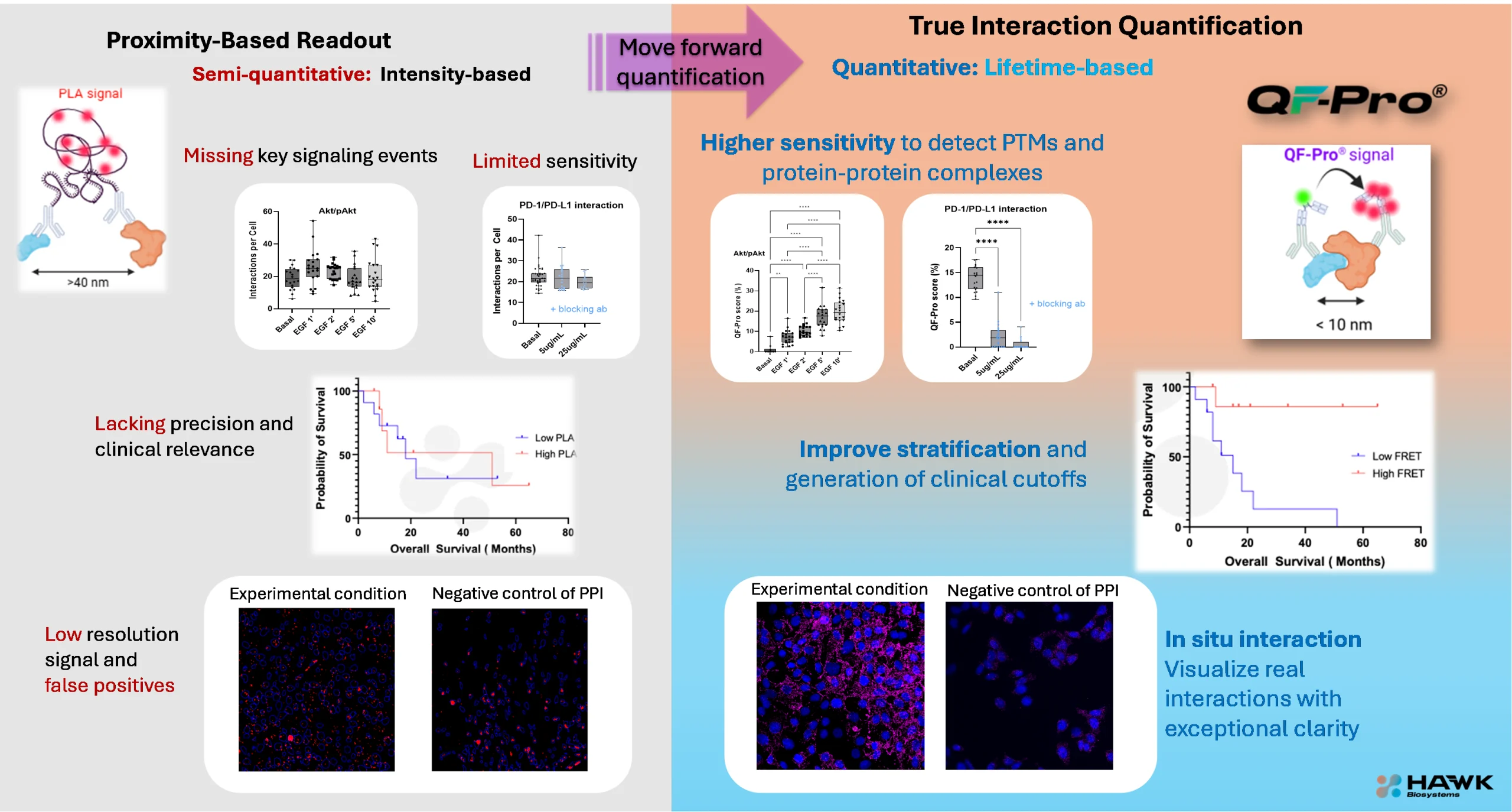
QF-Pro® replaces amplification- and intensity-weighted interpretation with a lifetime-derived quantitative interaction signal, enabling clearer discrimination between interaction vs non-interaction states. This improves the robustness of in situ interaction mapping and supports stratification analyses and cut-off definition in translational studies.
Key Benefits
- True low-distance interaction readouts (<10 nm) to reduce ambiguity from long-range proximity signals.
- Quantitative lifetime-derived outputs that are less dependent on intensity and amplification effects
- High dynamic range suited for cohort-level comparisons and stratification analyses
- In situ interaction mapping with strong spatial interpretability in tissue
- Built for translational research, supporting the development of robust, biologically meaningful biomarkers
Validated biomarkers:
Protein-protein interactions (PPIs)
- PD-1/PD-L1
- CTLA-4/CD80
- TIGIT/CD155
- LAG3/MHC-II
- TIM3/Gal9
- OX40-OX40L
- CD69/Gal1
- HER2/HER3
- HER3/EGFR
- HER2/EGFR
- Podocalyxin/Beta-catenin
- Podocalyxin/NHERF-1
- PD-1/SHP-2
- Cyclin E/CDK2
- Beta-catenin/E-cadherin
- PKB/PDK1
Post-translational modifications (PTMs)
- Akt/PKB activation state (pT308)
- EGFR activation state (pY1068)
- Rb activation state (pS807/811)
- STAT3 activation state (pY705, pS727)

Meet HAWK Biosystems in Germany
In the summer of 2026 HAWK Biosystems and Future Lab Innovations will hit the road together and visit research centers and scientific events to:
- Introduce QF-Pro® in immune-oncology contexts
- Discuss immune checkpoint biomarker validation strategies and study design
- Explore how in-situ interactomics can complement your existing discovery pipeline
Schedule a visit to your facility now