

Unlike conventional manufacturing approaches, bioprinting creates living constructs that continue to mature after fabrication. The printed architecture provides the initial blueprint, but tissue development is ultimately driven by cellular behavior and interactions with the surrounding microenvironment.
By combining biomaterials, cells, and biofabrication strategies, researchers can engineer constructs that progressively acquire structural and functional characteristics of native tissues. This dynamic maturation process is fundamental to regenerative medicine, where the goal extends beyond replicating tissue geometry to supporting tissue development, remodeling, and ultimately functional regeneration.
Bioprinting for tissue regeneration
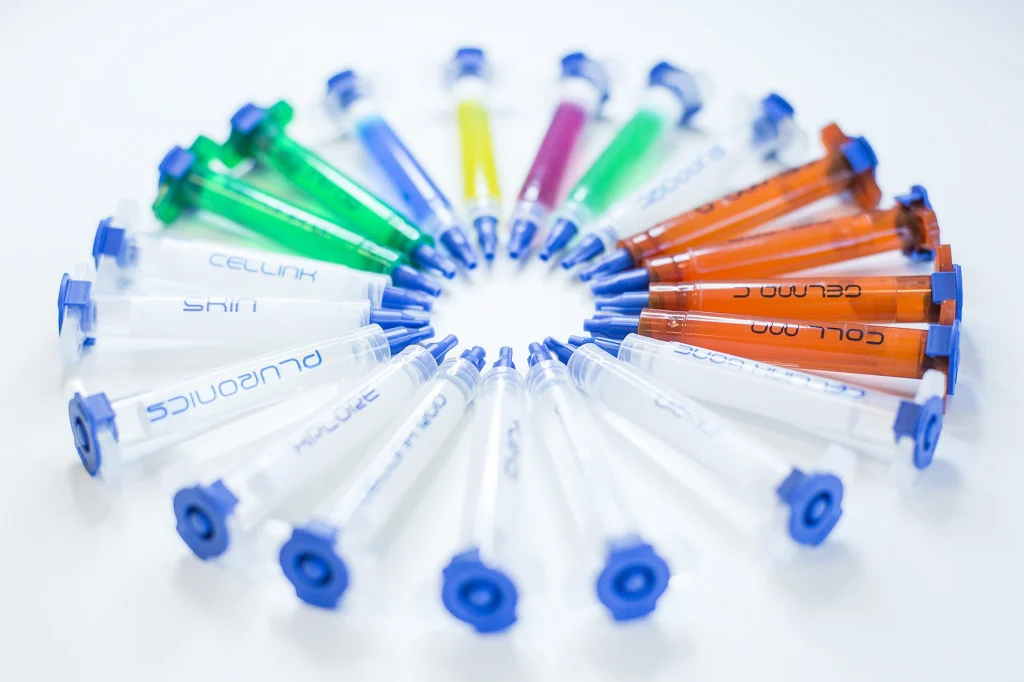
Regenerative medicine integrates bioengineering and medicine to create functional tissues and organs. One of the most exciting aspects of bioprinting is the ability to combine bioinks with living cells or to seed cells onto printed scaffolds, creating functional tissue constructs.
This technology is having a significant positive impact in the field of tissue regeneration, transplantation medicine, drug-screening models and personalized medicine.
Dynamic tissue maturation and 4D bioprinting
What makes bioprinting particularly unique is that the printed construct is not a finished product. Because it contains living cells, it continues to develop after printing. The cells communicate, proliferate, differentiate, and organize themselves into increasingly complex tissue structures. Dependent on such as self-organization behavior of the cells, some printed models can undergo significant changes in space and spatial organization over time or due to an external impulse. In the field, these dynamic remodeling processes are even referred to 4D bioprinting.
Sources and references:
- Kazemi Maralbashi, December 2025, BioMedical Engineering OnLine, Advances in 3D bioprinting for medical application: opportunities and challenges, https://link.springer.com/article/10.1186/s12938-025-01498-y
- Murphy & Atala, August 2014, Nat Biotechnol, 3D bioprinting of tissues and organs, DOI:10.1038/nbt.2958
- Baruch et al., January 2026, Adv. Mater., One-Step Coordinated Multi-Kinetic 4D Printing of Human Vascularized Cardiac Tissues with Selective Fast-Shrinking Capillaries, DOI: 10.1002/adma.202512879
- Li et al., November 2025, Medical Engineering & Physics, A comprehensive review on the printing efficiency, precision, and cell viability in 3D bioprinting, https://doi.org/10.1016/j.medengphy.2025.104448
