
The ability to precisely position cells and biomaterials has established 3D bioprinting as a core technology in tissue engineering. From large, multicellular constructs to highly detailed microarchitectures, different bioprinting modalities provide the flexibility to engineer tissue models that closely replicate the organization and function of native tissues.
Extrusion bioprinting for large and heterogeneous tissue constructs
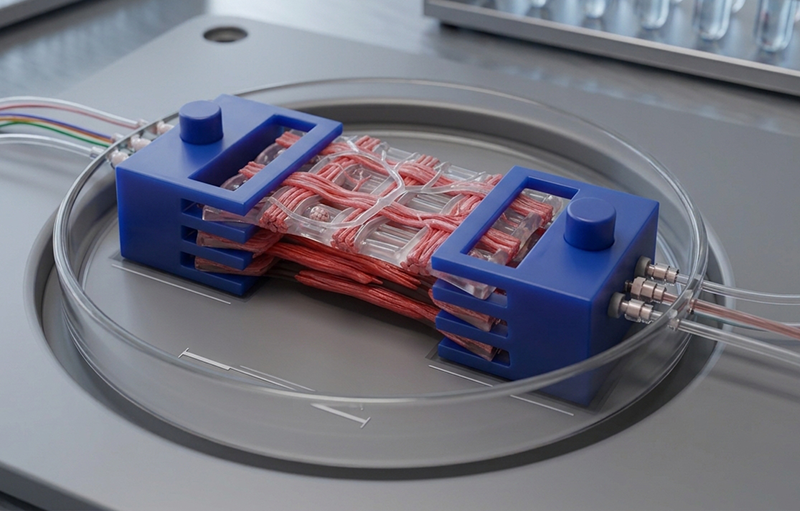
3D bioprinting has emerged in the field of tissue engineering, reshaping complex tissues and organs. Different technologies in 3D bioprinting can be used for this.
As an example, extrusion-based bioprinting is widely used for tissue engineering applications. It makes it possible to create large-scale tissue constructs such as vascularized skin, bone or cartilage, achieved by creating models with different cell types and materials.
High-resolution tissue fabrication with DLP bioprinting
Additionally, Digital Light Phase (DLP) bioprinting allows to create vascularization within a printed construct with a high resolution, important for more complex organs, such as the brain or cardiac tissues.
Application in tissue engineering and disease modeling
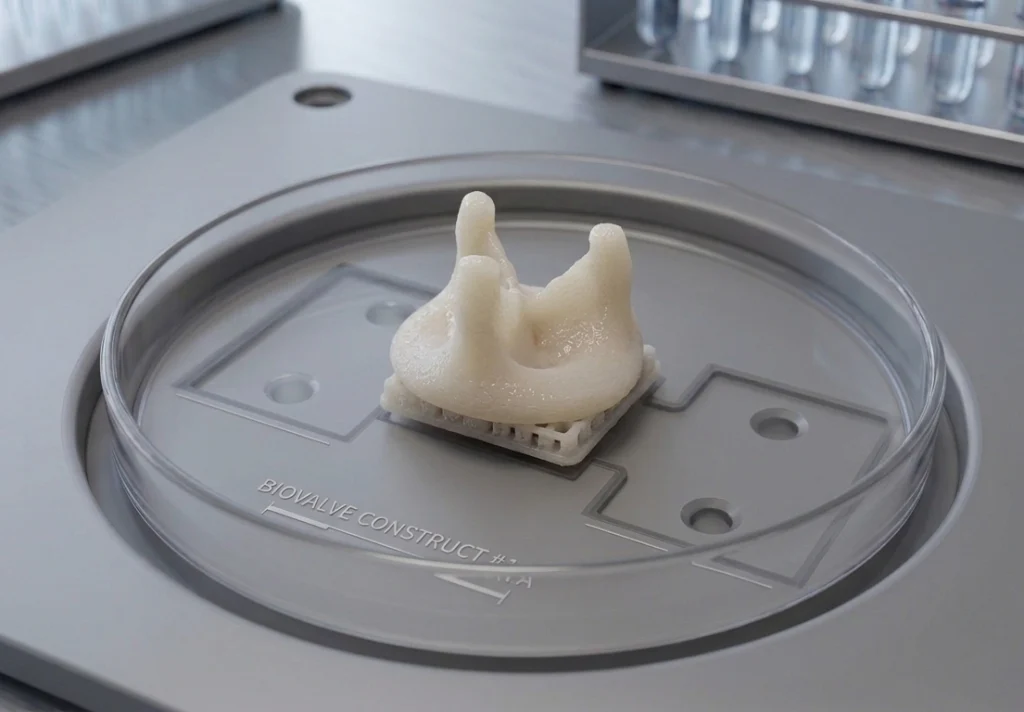
Tissue Engineering using 3D bioprinting technologies enabled bioprinting of a heart valve with patient specific size (Savoji Lab University of Montreal). Reseachers also created complex skin constructs to study inflammatory reactions or metabolism amongst other things. Next to these examples, cancer models are also being studies with 3D bioprinted tissues.
Sources and references:
- Murphy & Atala, August 2014, Nature Biotechnology, 3D bioprinting of tissues and organs, DOI:10.1038/nbt.2958
- Hwang et al., July 2025, Nano Micro Small, Augmented 3D Printing for Multiscale Microphysiological Systems, https://doi.org/10.1002/smll.202504750
- Schmid et al., April 2024, Mater Today Bio, A vascularized in vivo melanoma model suitable for metastasis research of different tumor stages using fundamentally different bioinks, DOI: 10.1016/j.mtbio.2024.101071
- Bioprinting pediatric heart valves that stand the test of time, University of Montréal, CELLINK, https://www.cellink.com/customer-spotlight/bioprinting-pediatric-heart-valves-that-stand-the-test-of-time/
- Kang et al., May 2024, Advanced NanoBiomed Research, Evaluation of Anti-inflammatory Activity of Garlic Extracts in 3D Bioprinted Skin Equivalents, https://doi.org/10.1002/anbr.202400007
- Jäger et al., July 2023, Tissue Eng Regen Med, Reconstructed Human Skin with Hypodermis Shows Essential Role of Adipose Tissue in Skin Metabolism, https://doi.org/10.1007/s13770-023-00621-1
Are you working in the Benelux or DACH-region?
We are here to help you with all your 3D bioprinting questions. Just reach out to us!

